Best SEO Strategies in 2026: The Whole Cake and iGaming Cherry on Top
Author

Alina Kalinichenko
Head of 360 SEO

Ivanna Flynn
By Alina Kalinichenko & Ivana Flynn
2025 was a wild year. Not just because of Google updates — there were actually fewer of those than usual — but because the whole landscape shifted. Black hat practices exploded. Negative SEO attacks hit an unprecedented scale. The market changed faster than most teams could adapt. And somewhere in the middle of all that chaos, the old SEO playbook quietly stopped working.
This article is our attempt to put everything we know — and everything we have been discussing, arguing about, and testing with real clients — into one place. It is not a list of quick wins. It is a framework for how to think about SEO in 2026 and beyond: what to prioritise, what to build, what to defend, and what is coming next that you need to be ready for.
We have structured it in layers: generic strategic concepts first, then precise technical and on-page recommendations, then the AI angle — which is real but widely misunderstood — and finally iGaming-specific guidance split between content-focused and product-focused projects, because the two are genuinely different beasts.
Part 1: Generic Strategic Concepts — How Winners Think in 2026
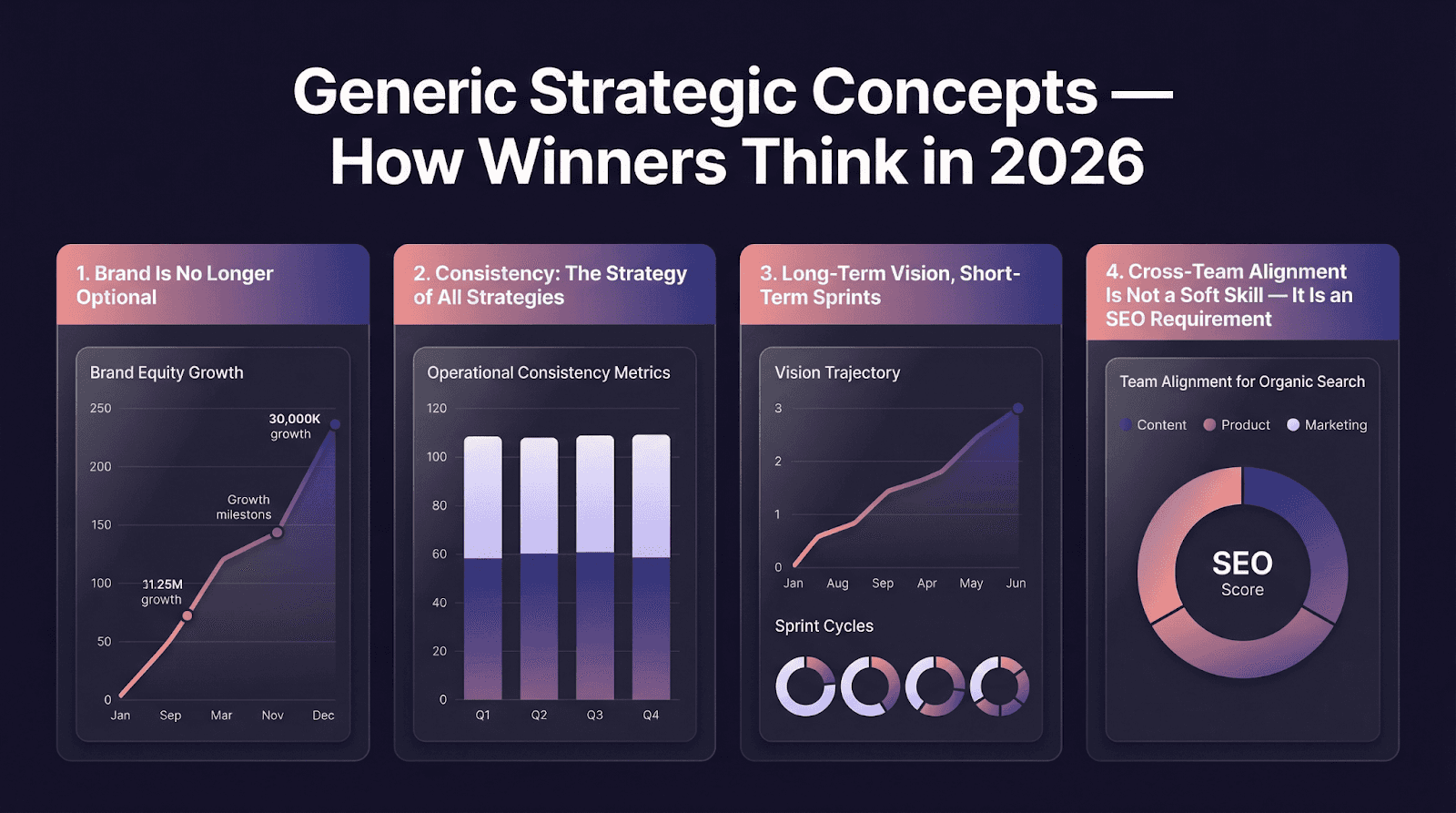
1.1 Brand Is No Longer Optional
If there is one strategic shift that defines 2026, it is this: brand is now the foundation, not a bonus. For years, SEO in competitive niches — and iGaming in particular — was largely a game of keywords and links. Build enough of both, and you're ranked. That is still partially true, but the margin for purely keyword-driven sites has collapsed.
What has replaced it? Brand recognition. Brand search volume. Direct traffic. Trust signals. These are the things that stabilise rankings when algorithm updates hit and when competitors start attacking you — and they will attack you.
Brand focus has to be the DNA of the entire company, not just an SEO task. That means:
A clear and unique brand identity — one that all teams, from product to content to tech, understand and work within.
Consistent positioning across every single touchpoint: metas, headings, logo, UX, promotional language, bonus structures, tone of voice. Everything has to be in harmony.
A brand name that is genuinely memorable, non-generic, and not mixed up with competitors or irrelevant terms. If you are starting a new website today — affiliate or operator — and you are choosing between a generic name like "online-casino-reviews-101" and something unique that people will remember, choose the unique name. Every time. It is easier to build a backlink profile around, it generates direct traffic (which is a strong signal to Google), and it becomes something you can build a persona and a community around. Brand search volume is SEO gold. It stabilises your traffic precisely when generic rankings drop.
And consistency is not just visual. It is strategic. Every content decision, every partnership, every PR piece should reinforce the same positioning. SEO teams need to be deeply aligned with commercial, product, and marketing teams — not operating in a silo.
1.2 Consistency: The Strategy of All Strategies
This one sounds obvious. It is not. The number of websites that zig-zag between strategies based on the latest industry panic is remarkable. One month they are chasing AI overviews. The next they are migrating the site. The next they are doing a full content audit because traffic dropped.
Consistency in 2026 means committing to a long-term vision while executing in short, adaptive cycles. It means not abandoning what is working just because something shiny appeared. It means building incrementally, measuring honestly, and staying the course even when progress feels slow.
In 2026, the sites that win are the ones that have been consistently building — brand, authority, technical quality, and backlink profiles — for 12, 18, 24 months. There is no shortcut to that compound effect.
1.3 Long-Term Vision, Short-Term Sprints
One of the most practical structural recommendations we can give is this: plan long, execute short. For this and upcoming years, set a strategic direction for 10-12 months or more. But operate in 1–3 month sprints.
Why? Because the SEO environment changes fast. An algorithm update, a competitor attack, a technical issue, a SERP layout change — any of these can shift your priorities completely. A rigid 12-month execution plan becomes a liability. A flexible sprint model lets you respond without losing strategic direction.
Each sprint should include:
A technical audit — are there new crawlability or indexation issues? Are pages loading correctly? Has anything broken?
A performance review — which pages are gaining or losing impressions and clicks? Are the right pages ranking for the right terms?
A priority reset — based on what the data shows, what should the next 4–8 weeks focus on?
A content and off-page check — is the content still relevant and competitive? Are new links being built, or is the profile stagnating?
Working blindly on a plan you set eight months ago, without checking whether it is still working, is one of the most common and most costly mistakes in SEO.
1.4 Cross-Team Alignment Is Not a Soft Skill — It Is an SEO Requirement
SEO in 2026 cannot live in a single team's hands. Technical decisions made by developers without SEO input cause crawl issues. Content produced without a commercial context wastes budget. PR activities disconnected from link strategy miss major opportunities.
The best-performing websites we have worked with are those where the SEO team has a real seat at the table — involved in product roadmaps, migration planning, content strategy, and commercial decisions. If your SEO is downstream of everything else, you are already at a disadvantage.
Practically, this means regular shared meetings between SEO, tech, content, and commercial teams. It means SEOs educating stakeholders on what they need and why. And it means leadership understanding that SEO is not a cost centre — it is a compounding acquisition channel that needs consistent investment and cross-functional support.
Part 2: Technical SEO — Excellence Is the Entry Ticket
Many websites in iGaming — both operators and affiliates — are sitting on unresolved technical issues that are silently blocking their growth. Sometimes it is something basic. Sometimes it has been known about for months and deprioritised. In both cases, no amount of content or links will fix a site that Google cannot properly crawl, understand, or serve.
Technical excellence is not a one-time project. It is an ongoing discipline. Here is what to focus on in 2026.
Technical SEO is a core part of our Full SEO Services, where we pay significant attention to the website's tech setup. We make sure to detect and eliminate any blockers and issues that might affect the website's growth.
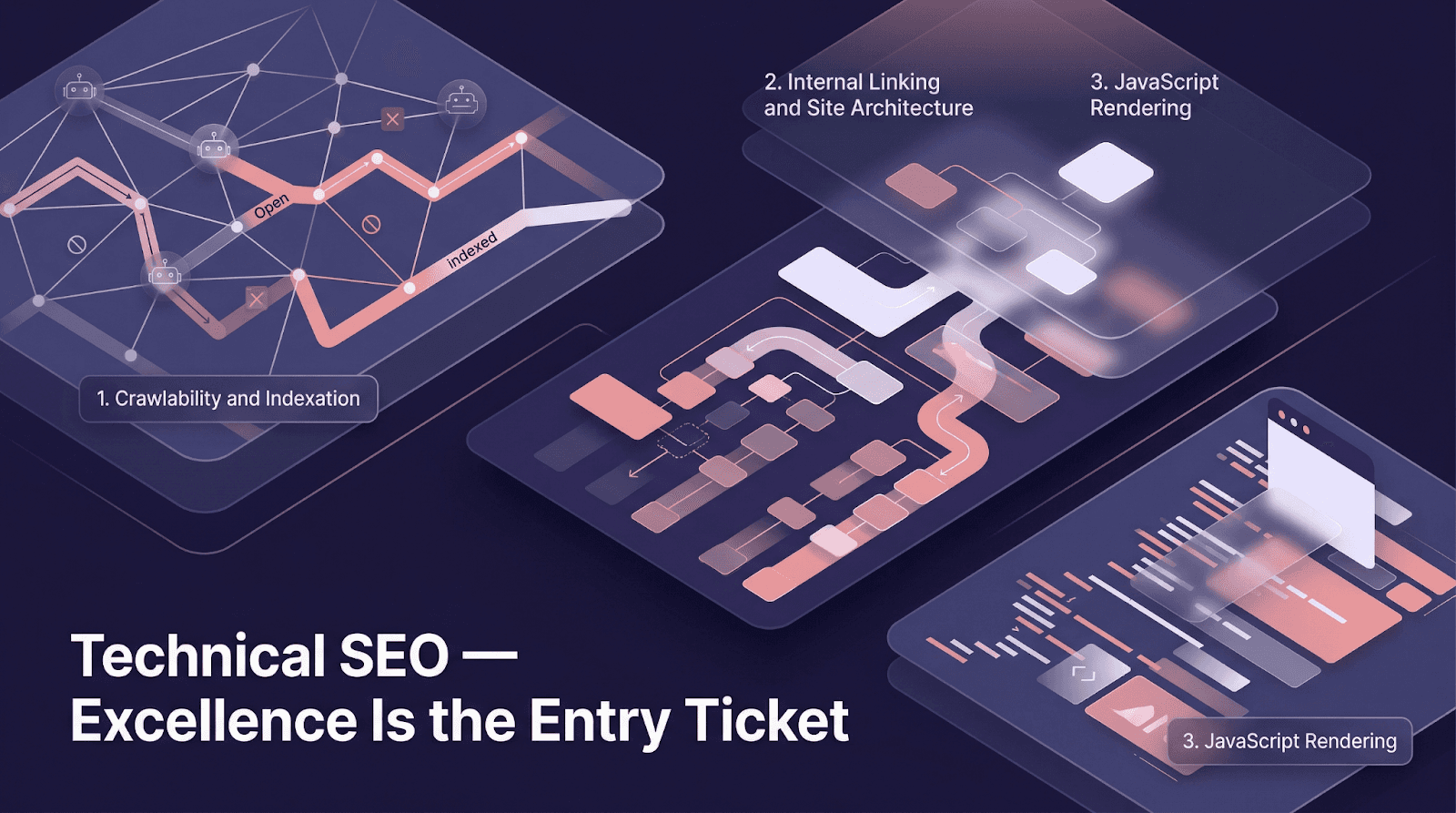
2.1 Crawlability and Indexation
The foundation. If Google cannot find your pages, index them correctly, or understand their canonical signals, everything else is irrelevant. In 2026, the most common and damaging issues we see are:
Canonicalization errors — either self-referencing canonicals that are inconsistently implemented, or incorrect canonicals pointing to the wrong pages. This is also, not coincidentally, one of the most heavily abused black hat techniques right now (canonicalization abuse), so getting your own implementation right is both a hygiene issue and a defence.
Robots.txt and noindex misconfigurations — accidentally blocking important pages or allowing crawl budget to be wasted on paginated, filtered, or low-value URLs.
Sitemap issues — missing pages, including non-indexed URLs, not reflecting the current site structure.
Duplicate content at scale — a persistent problem for iGaming sites with large game libraries, multiple geo-targeted versions, or templated bonus and promotion pages.
Run a full crawl with a tool like Screaming Frog or Sitebulb at the start of every sprint. Do not assume the indexation picture is clean just because it was clean three months ago. Sites change constantly, and issues compound.
2.2 Internal Linking and Site Architecture
Internal linking is one of the highest-leverage technical SEO activities, and one of the most neglected. A well-structured internal linking system does three things: it helps Google understand the relative importance of your pages, it distributes link equity efficiently, and it helps users navigate, which signals quality.
For iGaming sites specifically:
Homepage and key category pages (casino, sports betting, slots, etc.) should receive the most internal links from across the site — not just from the navigation, but from contextually relevant content pages.
New or recently updated pages need internal links pointing to them, or they will be slow to be discovered and indexed.
Orphan pages — pages with no internal links pointing to them — are a common problem on large affiliate and operator sites. They receive no link equity and often rank poorly or not at all. Audit for these regularly.
Anchor text should be varied and contextually relevant, not keyword-stuffed. Over-optimised anchor text on internal links is a signal Google does not like.
Site architecture should reflect business priorities. If slots pages are your primary commercial driver, the architecture should make that clear through depth (number of clicks from homepage) and internal link volume. If you have buried your most important pages three or four clicks deep, fix it.
2.3 JavaScript Rendering
JavaScript rendering issues are a silent traffic killer, particularly on heavily tech-built casino and sportsbook platforms. If your core content — game descriptions, odds, reviews, category text — is rendered client-side via JavaScript, there is a meaningful risk that Googlebot is not seeing it correctly.
Google has improved JavaScript rendering significantly, but it is still not reliable for all cases, and rendering is queued and delayed. The result is content that is technically on the page but not indexed, or indexed with a significant lag.
Recommendations:
Audit how Googlebot sees your key pages using Google Search Console's URL Inspection tool, particularly the "View Crawled Page" option. Compare what Googlebot sees versus what a user sees.
For critical content — homepage copy, category introductions, game metadata, key landing page text — implement server-side rendering (SSR) or static generation. Do not rely on client-side JS for content that needs to rank.
If a full SSR migration is not feasible short-term, dynamic rendering as a transitional solution is acceptable, though not ideal long-term.
Regularly test site speed and Core Web Vitals — JavaScript-heavy sites are disproportionately likely to fail INP (Interaction to Next Paint) and LCP benchmarks.
Part 3: On-Page Strategy and Content — Quality Over Quantity, Always
3.1 Content That Earns Its Place
The days of publishing thin content at scale and ranking on volume are over for any serious market. Google's quality signals have matured enormously, and the iGaming SERP in 2026 is mercilessly competitive. Every page needs to justify its existence.
What does that mean in practice?
Audit your existing content before creating new content. Merge pages that are cannibalising each other. Redirect or consolidate low-quality pages. A smaller set of strong, well-optimised pages outperforms a bloated site full of thin content.
Prioritise depth over breadth. One comprehensive, genuinely useful page about a topic will consistently outperform five shallow ones.
Keep content up to date. Freshness matters, both as a ranking signal and as a trust signal for users. Outdated bonus terms, old game information, or stale reviews actively damage credibility.
3.2 Conversational Narrative and AI-Ready Structure
The way content needs to be structured is changing, driven largely by how AI systems consume and summarise information. Content that is written as a natural dialogue — questions and answers, clear problem-solution structures, direct responses to user intent — performs better both in traditional rankings and in AI overviews.
Practical changes to make:
Reframe headings as questions where appropriate. "What is the best casino bonus in 2026?" rather than "Casino Bonuses 2026". This aligns with how people actually search and how AI systems parse intent.
Use precise, well-structured FAQs on every key page. Not generic filler FAQs — specific, genuinely useful questions that your target users actually ask.
Write introductions that directly answer the primary query before elaborating. Do not bury the answer.
Diversify content formats: written guides, comparison tables, video content, interactive tools. Different formats serve different user needs and send broader quality signals.
3.3 Localisation as a Competitive Advantage
In iGaming, especially, localisation is not just translation. It is full cultural and regulatory adaptation: local payment methods, local bonus terminology, local regulatory language, local search behaviour. Sites that do localisation properly — with native-level quality and genuine local relevance — consistently outperform those that rely on machine translation or templated content.
Localisation also applies to backlink strategy and PR. Local mentions, local media coverage, local forum presence — these are increasingly powerful signals, particularly for geo-targeted ranking.
Part 4: Off-Page Strategy — Build, Defend, and Diversify
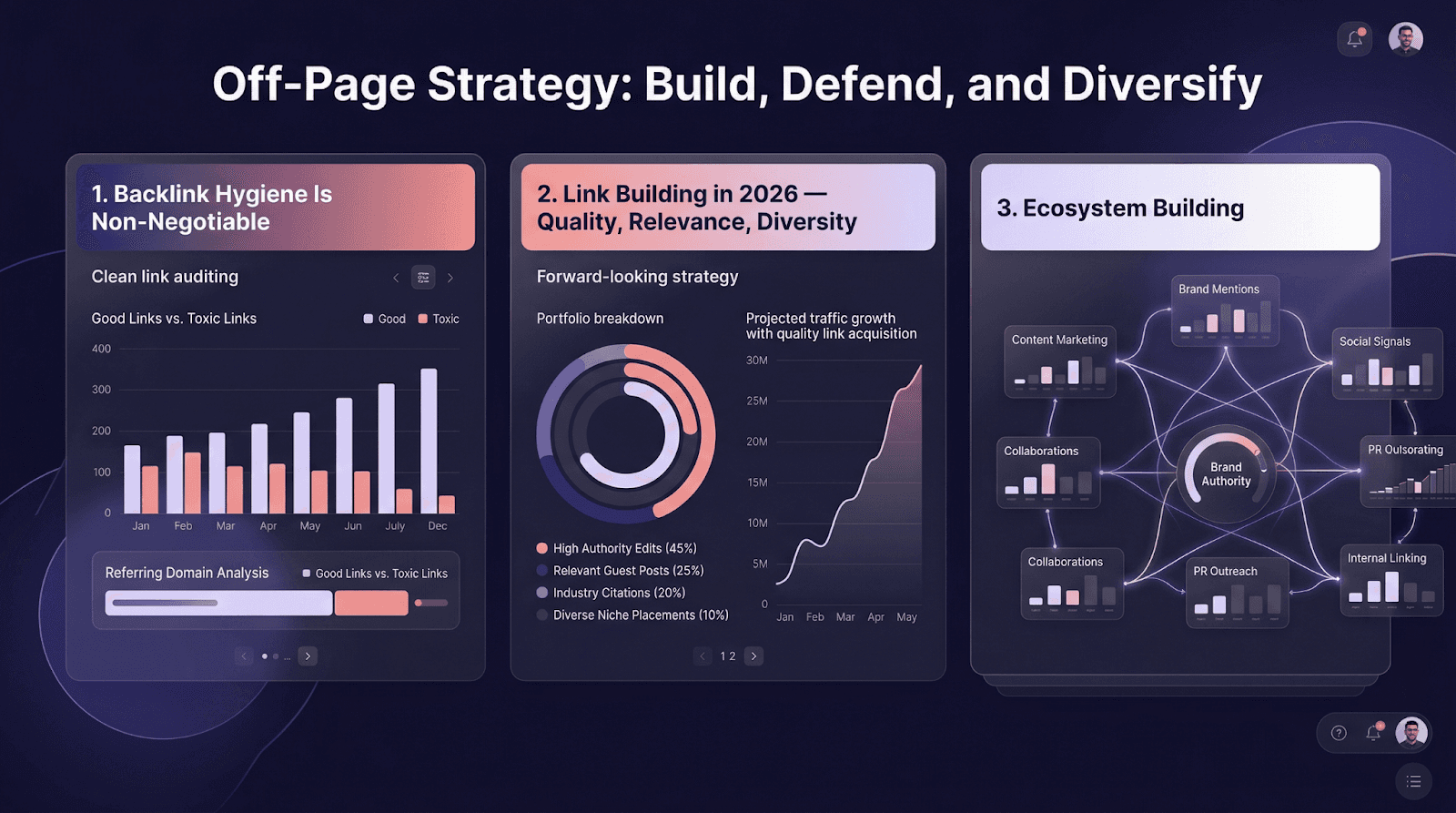
4.1 Backlink Hygiene Is Non-Negotiable
Negative SEO is real, it is widespread, and it is not going away. 2025 saw an extraordinary volume of link-based attacks across iGaming — spam floods, UGC injections on forums, toxic link packages targeted at competitor domains. Tools make it easy to dump hundreds of thousands of low-quality links at any site.
The response is not panic — it is hygiene. Maintain a regular disavow process. Monitor your backlink profile with tools like Ahrefs or Semrush at least monthly. Set up alerts for unusual link velocity spikes. And accept that disavowing alone may not be enough if an attack is heavy — you also need to actively build positive signals to counterbalance.
Work closely with your PR team to ensure positive brand mentions, coverage, and citations are being built consistently.
When negative content or mentions appear, respond with volume on the positive side — more coverage, more authoritative links, more brand signals.
For new websites, establish clean backlink hygiene from day one. It is significantly easier to maintain than to fix.
4.2 Link Building in 2026 — Quality, Relevance, Diversity
The fundamentals of link building have not changed, but the execution has to be sharper. A few high-quality, contextually relevant links from authoritative domains in your niche are worth more than hundreds of directory listings or irrelevant guest posts.
What works:
Link insertions into existing, already-ranking content on relevant sites. These carry strong signals because the page already has traffic and authority.
Digital PR — creating newsworthy content (original research, industry data, interesting collaborations) that earns links naturally. The goal is to build sources, not just backlinks. Content that other people cite and link to repeatedly is an asset that compounds over time.
Niche-relevant platforms — Reddit, Quora, and industry-specific forums. Not for spam, but for genuine presence, value-adding contributions, and brand mentions. These platforms are heavily indexed and increasingly cited in AI outputs.
Localisation of off-page activity — building presence in local media, local forums, and local review platforms in each target market.
Looking to strengthen your backlink profile in 2026? We offer two options: Off-page Managed services, where we handle everything end-to-end, and a Self-serve Backlink platform, where you stay in control, and our support team is there when you need them — no extra fees.
4.3 Ecosystem Building
This is the off-page concept that most SEO teams are not yet thinking about seriously enough. The idea is simple: do not just build a website, build an environment. Create platforms, tools, communities, or content formats that complement your main product and generate organic user signals.
Some operators — Stake being a well-known example — have built streaming, community, and content ecosystems around their core product. The SEO benefit is significant: UGC, natural brand mentions, social signals, and the kind of organic brand recognition that AI systems respond to. It is not just a growth strategy — it is an authority strategy.
Smaller brands can do this too, in proportion to their resources. A useful tool, a community forum, a research publication, a newsletter. Anything that makes your brand a source of information and not just a commercial destination.
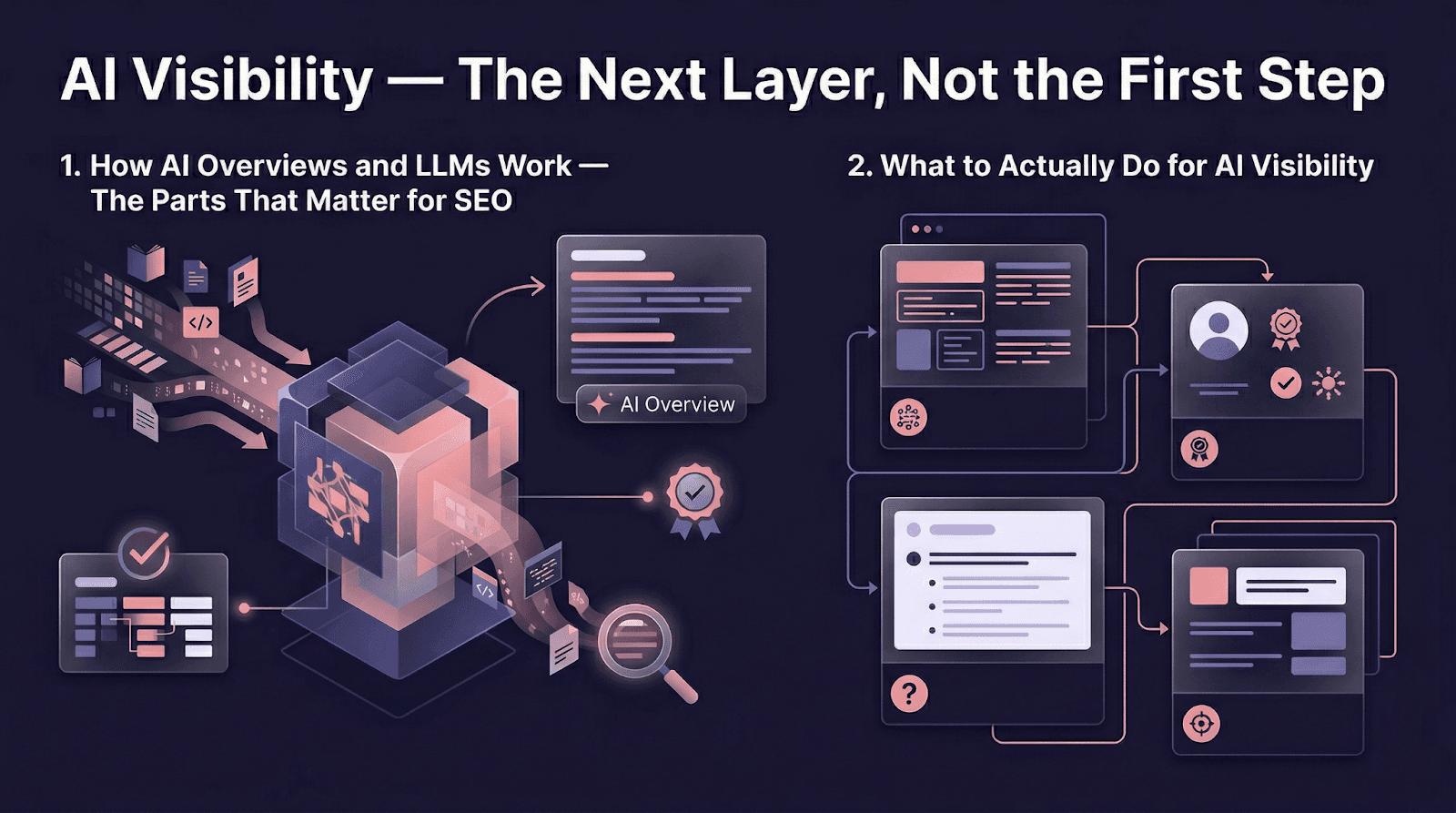
Part 5: AI Visibility — The Next Layer, Not the First Step
Let us be direct about something: AI visibility is the topic everyone is panicking about, and most of that panic is premature — especially in iGaming, where Google's AI overviews are not yet showing up heavily for the core commercial keywords. That will change. But right now, the bigger risk is teams abandoning solid SEO fundamentals to chase AI ranking before their basics are in place.
Here is the framework we recommend: AI optimisation is a layer you add on top of polished SEO — not instead of it, not before it. If your site is not ranking in regular search results, you will not appear in AI overviews either. The algorithmic foundations are the same. Get the basics right first.
At Motherlink, we keep our AI SEO Services up to date with the latest developments — so our clients are always working with current techniques, not last year's best guesses.
5.1 How AI Overviews and LLMs Work — The Parts That Matter for SEO
A few things we know about AI overviews that are worth keeping in mind:
Results in AI overviews are not stable. Unlike positions 1–3 in organic search, which are relatively consistent, AI overview results vary significantly between queries and over time. Only about 16% of the same results appear consistently. This means AI visibility is harder to "own" than a traditional ranking.
You still need to rank to appear. AI overviews draw heavily from pages that rank in the top 20–30 results, not just the top 10. Strong on-page quality and topical authority matter.
LLMs like ChatGPT, Gemini, and Perplexity build their knowledge from what is available and cited on the web. Being mentioned on authoritative third-party platforms — Reddit, industry publications, review sites — is how you get cited in LLM outputs. This is fundamentally an off-page and brand-building challenge.
5.2 What to Actually Do for AI Visibility
Content
Write in a conversational, dialogue-like format — AI systems parse intent and direct answers well.
Structure content with clear question-and-answer formats, precise FAQs, and direct responses at the top of each section.
Keep content fresh and up to date. Recency is a significant factor in what AI systems surface.
Diversify content types — video content specifically is emerging as a meaningful signal for AI systems. Do not ignore it.
Technical
Ensure all key content is properly crawlable and indexable — AI systems cannot cite what they cannot see.
Implement structured data (schema markup) where relevant — FAQ schema, Review schema, Article schema. This helps AI systems understand the nature and context of your content.
Page speed and Core Web Vitals remain relevant — slow, poor-experience pages are deprioritised.
Off-Page and Brand
Be present and active on platforms that AI systems reference heavily: Reddit threads, Quora answers, industry forums, and publications. Not just with backlinks — with genuine, useful contributions that include your brand name in context.
Build your own ecosystem — brand ecosystems generate the kind of distributed, user-generated brand signals that LLMs pick up and use.
Invest in PR and original research. Being cited as a source — not just linked — is what gets your brand into AI answers. Think about what information you uniquely have that others would reference.
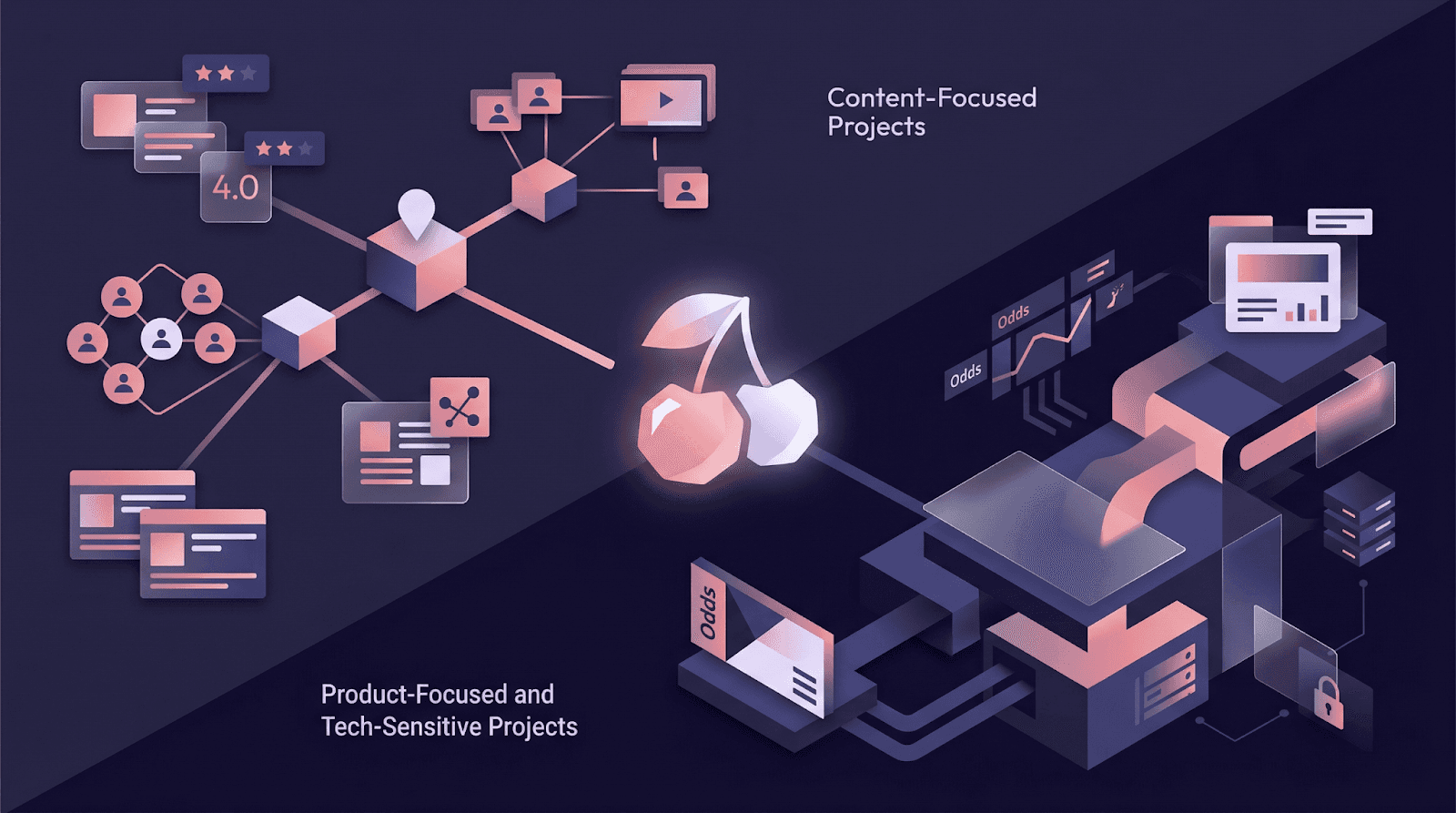
Part 6: The iGaming Cherry on Top
iGaming is not a single category. The SEO challenges and opportunities for a content-heavy affiliate are fundamentally different from those facing a large operator or platform. Here is how we think about the two.
6.1 Content-Focused Projects — Affiliates, Review Sites, Small Providers
Content-focused projects live and die by their ability to rank for informational and commercial intent queries. Their main assets are editorial quality, topical authority, and backlink profiles. Their main vulnerabilities are algorithm sensitivity — particularly to content quality updates — and negative SEO attacks.
Brand: start here
If you are an affiliate and you do not have a strong, memorable brand name — one that generates its own search volume — this is your most important strategic priority for 2026. Generic names are being increasingly devalued. A recognisable brand builds trust, generates direct traffic, and makes all your other SEO activity more effective.
Topical authority over keyword targeting
The shift from individual keyword targeting to topical authority is real and significant. Google increasingly rewards sites that demonstrate comprehensive, expert-level coverage of a subject area, rather than those that have optimised individual pages for individual keywords.
For an affiliate site covering online casinos, this means building full coverage of the topic — not just "best online casinos UK" but game guides, payment method explanations, responsible gambling resources, casino news, provider reviews, and so on. The goal is to be the authoritative resource in your niche, not just the page that ranks for one query.
Content quality over content volume
Publish less, publish better. A well-researched, genuinely helpful, regularly updated review page will outperform five thin ones. Audit existing content ruthlessly — consolidate where pages are cannibalising each other, redirect or remove pages that add no value.
AI-optimised content formats
Affiliates are well-positioned to benefit from AI visibility if they structure their content correctly. FAQ-heavy, conversational, question-structured content is what AI systems prefer. Affiliates that reformat their existing strong content to be more AI-readable — while maintaining quality — have an edge here.
Backlink profile and defence
Affiliates are disproportionately targeted by negative SEO because a successful affiliate is a direct revenue threat to whoever they are outranking. Maintain rigorous backlink hygiene, monitor link velocity, and have a disavow workflow ready to execute quickly. Build positive brand signals consistently so that attacks have less impact.
6.2 Product-Focused and Tech-Sensitive Projects — Operators, Sportsbooks, Large Platforms
Product-focused projects have a different set of challenges. Their sites are typically large, technically complex, and built on platforms or frameworks that were not designed with SEO as a primary concern. The opportunities are also larger — but so are the risks.
If your team needs support — whether that's full-circle SEO, a technical audit, AI visibility, or backlink acquisition — we offer Casino SEO Services that can be tailored to where you actually are and what you actually need.
Technical excellence first, always
For large operator and platform sites, technical SEO is the highest-leverage activity. A single template fix can impact tens of thousands of pages. A JavaScript rendering issue can effectively de-index an entire product category. An internal linking structure change can redistribute page authority across the whole site.
Prioritise:
Crawlability and indexation at scale — with large sites, issues compound. Regular full-site crawls are essential.
JavaScript rendering — platform-built casino and sportsbook sites are particularly prone to client-side rendering issues that make content invisible to Googlebot. Audit, identify, fix.
Site architecture — does the structure reflect commercial priorities? Are the highest-value pages getting the most internal link equity?
Template-level optimisation — with thousands of game pages, slot pages, or event pages, getting the template right has massive leverage. One good template change outweighs hundreds of individual page fixes.
Localisation at scale
For operators running multi-market, multi-language sites, localisation is both a massive opportunity and a massive risk. Proper hreflang implementation, locale-specific content (not just translation), and geo-targeted backlink strategies are the difference between dominating a market and being invisible in it.
Common mistakes at scale: duplicate content across locales, incorrect or missing hreflang tags, machine-translated content that passes technical checks but fails quality signals, and shared backlink profiles across markets rather than locally-relevant link building.
Most iGaming projects target multiple markets, and international execution is where a lot of value gets lost. At Motherlink, our International SEO Services are built specifically for multi-GEO iGaming — with real case studies and hands-on experience across markets.
Ecosystem and brand building
Large operators have the resources to build genuine brand ecosystems — community platforms, streaming, UGC mechanisms, loyalty programmes with an SEO dimension. The operators who are investing in this now are building a moat that will be very hard to compete with purely on a keyword and link basis in two to three years.
Aligning SEO with CRM, product, and brand teams to ensure that user engagement, retention features, and brand loyalty activities are also generating SEO-positive signals — brand searches, branded links, social mentions — is a strategic multiplier that very few operators are fully exploiting.
Negative SEO defence at scale
Large operators are high-value targets. The attacks are not just link floods — they include brand reputation attacks, negative PR campaigns, and content designed to undermine trust. The defence is not just technical: it is brand equity, reputation management, PR investment, and deep monitoring of brand mentions across the web.
Final Thoughts
2026 is not the year SEO died. It is the year SEO grew up. The tactics that worked on shortcuts — thin content, link spam, generic keyword targeting — are reliably failing. What is working is harder to build and harder to copy: real brands, technical excellence, genuine authority, and consistent investment over time.
The iGaming industry specifically is in a fascinating moment. Black hat practices are more widespread than ever, the SERPs are more volatile, and AI is beginning to reshape how users find information. But the fundamentals — strong brand, clean technical foundation, high-quality content, diverse and natural backlink profile — have never been more important or more rewarding to get right.
The goal for 2026 is simple, even if the execution is not: build something that Google trusts, users value, and competitors cannot easily copy. And, make sure the LLMs know you exist too — because the search landscape no longer has a single gatekeeper. Everything else is tactics in service of that.
Good luck out there. It is a wild one ;)